
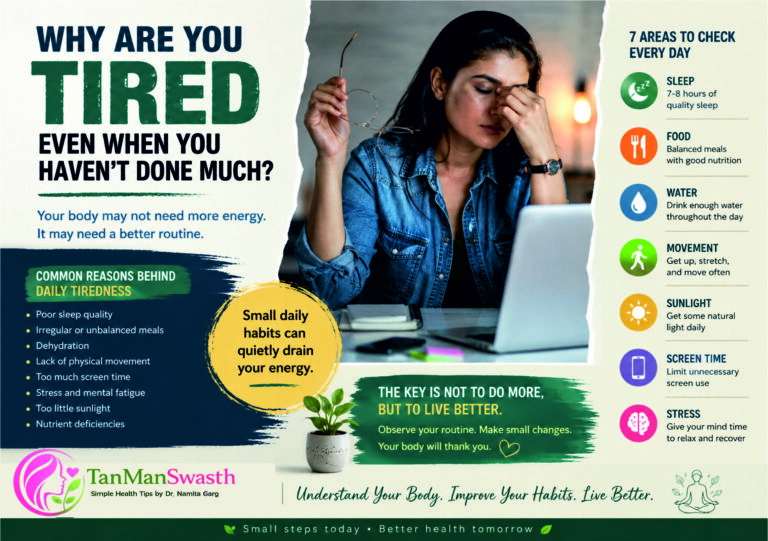
This is a very good awareness topic because it can cover the everyday things people overlook:
- Poor sleep quality
- Long sitting hours
- Too little movement
- Irregular meals
- Hidden dehydration
- Too much refined food
- Lack of protein
- Vitamin/mineral deficiencies
- Stress and mental fatigue
- Too much screen time
- Weekend-only exercise
- Lack of sunlight
- Poor daily routine
But the article would not diagnose fatigue or become a medical article.
The unique angle
Instead of the usual:
“10 reasons why you feel tired”
we make it:
“Your body may not be asking for more energy—it may be asking for a better routine.”
Then explain how small daily habits can quietly drain energy, even when a person thinks they are doing everything normally.
At the end, we can introduce a simple concept without making it a program:
The 7-Day Energy Awareness Check
For seven days, readers simply observe:
Sleep → Food → Water → Movement → Sunlight → Screen Time → Stress
No diet.
No supplements.
No complicated exercise plan.
Just observe your own day.
That gives us a natural opportunity later to develop a TanManSwasth program around “7-Day Energy Reset” or something similar.
If you like this direction, I can write the complete original TanManSwasth article, around 1,800–2,500 words, in simple English, with a strong opening, practical examples, SEO title, meta description, headings, FAQs, and a TanManSwasth-style conclusion.
ys its better write on it with most alluring and useful content so every viewer cant leave it in between without reading full article
Absolutely. This one should feel different from the usual health articles—more like the reader is discovering something about their own daily life as they read.
I would use this title:
Why Are You Tired Even When You Haven’t Done Much?
Your body may not need more energy. It may need a better routine.
Have You Ever Had This Kind of Day?
You wake up after what you believe was enough sleep.
You haven’t done any heavy physical work.
You have had breakfast, gone about your normal routine, perhaps sat at a desk or watched television—and yet by afternoon you feel strangely tired.
You tell yourself:
“I didn’t even do anything today. Why am I so tired?”
Then comes the second cup of tea or coffee. ☕
Maybe something sweet.
Maybe a short nap.
You feel better for a while.
And then the tiredness returns.
If this sounds familiar, you’re not alone.
But here’s something worth understanding:
Feeling tired is not always about how much work you did. Sometimes it is about how you lived the hours before the tiredness appeared.
Your body is constantly balancing sleep, food, hydration, movement, stress, sunlight, recovery and hundreds of other processes.
And sometimes, without realizing it, our everyday routine keeps taking small amounts of energy from us.
The Surprising Part: You May Be Spending Energy Without Feeling Active
Imagine two people sitting in a chair for six hours.
Both appear to be resting.
But one gets up regularly, drinks water, eats balanced meals, gets some sunlight and sleeps at a consistent time.
The other sits almost continuously, drinks very little water, eats irregularly, spends hours looking at screens, skips meals and sleeps at different times every night.
From outside, both people appear to be “resting.”
Inside the body, however, their days can be very different.
This is why “I don’t do much, but I feel exhausted” deserves a closer look at your routine.
1. The First Question: Are You Actually Resting When You Sleep?
Many people judge sleep only by its duration.
They think:
“I slept seven hours, so I should be fine.”
But sleep isn’t simply about the number on the clock.
Your sleep routine matters too.
Going to bed at very different times every night, using screens late into the night, waking repeatedly, or having an uncomfortable sleep environment can affect how refreshed you feel the next day.
Ask yourself:
- Do I wake up feeling reasonably refreshed?
- Do I feel sleepy soon after waking?
- Do I regularly need several cups of tea or coffee to feel alert?
- Do I stay on my phone until the moment I fall asleep?
- Do I sleep at roughly the same time most nights?
If the answer to several of these is “no,” your tiredness may have something to do with your sleep routine.
2. Your Body Doesn’t Run on Tea and Biscuits ☕
Here’s a common pattern:
Morning: Tea + biscuits
Mid-morning: Nothing
Lunch: Large meal
Afternoon: Tea + something sweet
Evening: Snacks
Dinner: Heavy meal
You may have eaten plenty of calories.
But calories and nutritional quality are not the same thing.
Your body needs a variety of nutrients, including protein, vitamins, minerals, healthy fats, carbohydrates and fibre.
A diet dominated by highly processed foods can leave you eating enough—or even more than enough—while still having a poor overall nutrient balance.
A better question than:
“How much did I eat?”
is:
“What did my food actually give my body?”
3. The Hidden Problem: You May Simply Be Drinking Too Little Water
Thirst isn’t always dramatic.
You don’t necessarily feel extremely thirsty when your fluid intake isn’t ideal.
Some people spend much of the day drinking tea, coffee or other beverages while barely drinking plain water.
Mild dehydration can be associated with symptoms such as headache, dizziness and tiredness.
So try a simple experiment:
Tomorrow, don’t wait until you’re very thirsty.
Keep water available throughout the day and drink regularly according to your needs, while taking into account your health conditions and your healthcare professional’s advice.
You may discover that what you thought was “low energy” was partly related to poor hydration.
4. Sitting All Day Can Make You Feel Surprisingly Drained
Here’s a strange contradiction:
You can be physically inactive and still feel exhausted.
Sitting for long periods can become part of a very sedentary routine.
You don’t have to become a gym enthusiast to change this.
Try something much simpler.
Every so often:
🚶 Get up
🚶 Walk around the room
🚶 Stretch
🚶 Do a household task
🚶 Walk while talking on the phone
Think of movement not only as “exercise.”
Think of it as breaking up long periods of inactivity.
Your body was designed to move throughout the day—not just for 30 minutes and then sit for the remaining 12 hours.
5. Your Body Loves Sunlight—But Your Routine May Not
Many people leave home in the morning, travel in a vehicle, work indoors, return home and spend the evening indoors again.
Days can pass with very little time outside.
Natural daylight helps regulate the body’s circadian rhythm, the internal timing system that influences sleep and wakefulness.
Getting some daylight during the day—especially earlier in the day—can be a useful part of a healthy routine.
And there is another reason people talk about sunlight and health:
Vitamin D.
However, sunlight exposure doesn’t guarantee adequate vitamin D, and vitamin D status can be affected by many factors. If deficiency is suspected, testing and professional advice are more reliable than simply assuming you need more sunlight or supplements.
6. Your Phone May Be Stealing More Than Your Time 📱
This one is easy to underestimate.
You sit down for “five minutes.”
You open your phone.
One video becomes another.
Messages arrive.
You scroll through social media.
Suddenly 45 minutes have disappeared.
The problem isn’t simply the screen itself.
It is what that screen time replaces.
It may replace:
- Movement
- Sleep
- Outdoor time
- Conversation
- Relaxation
- Hobbies
- Quiet mental recovery
And if screens keep you awake later than planned, the effect can continue into the next day.
Try asking yourself tonight:
“Am I using my phone—or is my phone using my time?”
That question alone can be surprisingly revealing.
7. Stress Can Make You Tired Even When Your Body Isn’t Moving
Mental work is still work.
Worrying about money.
Thinking about family problems.
Planning tomorrow.
Checking messages.
Constantly reacting to news.
Trying to remember everything you need to do.
Your body may be sitting quietly while your mind is running at full speed.
This can make genuine relaxation difficult.
You don’t necessarily need a complicated meditation program.
Sometimes recovery begins with something much simpler:
Give your brain periods when it doesn’t have to respond to anything.
Sit quietly.
Take a walk without constantly checking your phone.
Talk to someone you enjoy being with.
Listen to music.
Spend time outdoors.
Do something that doesn’t demand constant attention.
8. Don’t Blame Every Afternoon Slump on “Low Energy”
Many people experience an afternoon dip in alertness.
Then they immediately reach for:
☕ Coffee
🍪 Biscuits
🍫 Chocolate
🥤 Sugary drinks
Occasionally, that’s fine.
But if your daily strategy is:
Tired → sugar/caffeine → temporary boost → tired again
then you’re managing the symptom rather than examining the routine.
Instead, look at your entire day.
Did you sleep well?
Did you eat a balanced breakfast?
Did you drink enough water?
Did you move?
Did you have a very heavy lunch?
Did you spend hours sitting?
Did you sleep too little the previous night?
Your afternoon may simply be revealing what happened earlier.
9. Protein Is Often Missing From the Plate
One of the easiest ways to improve the nutritional quality of meals is to pay attention to protein.
Protein is important for maintaining muscles and many other body functions.
Depending on your dietary preferences, protein can come from foods such as:
🥚 Eggs
🥛 Milk and yogurt
🫘 Dal
🌱 Beans
🫛 Peas
🥜 Nuts and seeds
🌾 Soy foods
🐟 Fish
🍗 Chicken
🥛 Other dairy or fortified alternatives
You don’t need to turn every meal into a “high-protein diet.”
The important thing is to make sure your overall diet provides adequate protein for your individual needs.
10. Your Body May Be Asking for a Routine, Not a Stimulant
This may be the most important idea in this article.
When energy falls, our first reaction is often to add something:
More coffee.
More tea.
More sugar.
Energy drinks.
Supplements.
But sometimes the answer is to remove something:
Less late-night screen time.
Less sitting.
Less irregular eating.
Less highly processed food.
Less unnecessary stress.
Less inconsistent sleep.
And add something simple:
More regular movement.
More nutritious meals.
More water.
More daylight.
More consistent sleep.
More recovery.
The 7 Things You Should Observe for One Week
Don’t change everything tomorrow.
That usually fails because it is too much.
Instead, for the next seven days, simply observe these seven things:
💤 1. Sleep
What time did you sleep and wake?
🍽️ 2. Food
Did your meals contain a good variety of nutritious foods?
💧 3. Water
Did you drink regularly throughout the day?
🚶 4. Movement
How often did you get up and move?
☀️ 5. Daylight
Did you spend some time outdoors during the day?
📱 6. Screen Time
How much time did you spend on your phone unnecessarily?
🧠 7. Stress
Did you have any genuine periods of mental relaxation?
Don’t judge yourself.
Don’t try to score yourself.
Just observe.
You may notice a pattern you had never seen before.
But There’s Something Important You Shouldn’t Ignore
Not every case of tiredness is caused by lifestyle.
Persistent or unexplained fatigue can have many possible causes, including sleep disorders, anemia, thyroid problems, infections, medication effects, nutritional deficiencies and other medical conditions.
So don’t automatically assume:
“I just need to exercise more.”
If your tiredness is persistent, severe, worsening, unexplained, or affecting your daily life, speak with a qualified healthcare professional.
Seek urgent medical attention if fatigue occurs with concerning symptoms such as chest pain, severe shortness of breath, fainting, confusion, or other serious symptoms.
The Real Goal Isn’t to Feel Energetic Every Minute
This is another misconception.
A healthy person will still feel tired after a demanding day.
That’s normal.
The goal isn’t:
“I should never feel tired.”
The goal is:
“My daily routine should support my body rather than constantly working against it.”
There will be late nights.
There will be unhealthy meals.
There will be lazy Sundays.
There will be stressful days.
That’s life.
Health doesn’t require perfection.
It requires patterns.
What you do occasionally matters less than what you repeatedly do.
Tonight, Ask Yourself These 7 Questions
Before you go to bed, don’t ask:
“Did I have a productive day?”
Ask:
Did I sleep well?
Did I nourish my body?
Did I drink enough?
Did I move enough?
Did I get some daylight?
Did I spend my time wisely?
Did I give my mind a chance to recover?
You may find that the answer explains your energy tomorrow better than another cup of coffee does.
🌿 The TanManSwasth Takeaway
Your body doesn’t suddenly become tired at 3 PM.
Your 3 PM energy may be the result of what happened at 10 PM, 7 AM, 11 AM and 1 PM.
Sleep.
Food.
Water.
Movement.
Daylight.
Screens.
Stress.
They may look like separate parts of your life, but your body experiences them as one complete daily routine.
So the next time you say:
“I don’t know why I’m so tired.”
Don’t immediately reach for coffee.
Pause.
Look back at your day.
Your body may already be giving you the answer.
One Small Challenge
Tomorrow, change only one thing.
Wake up and drink some water.
Take a short walk.
Get some daylight.
Add a nutritious protein source to a meal.
Put your phone away 30 minutes before bed.
Choose whichever feels easiest.
Then notice how you feel.
Small changes repeated consistently are often more powerful than dramatic changes that last three days.
🌱 TanManSwasth — Understand Your Body. Improve Your Habits. Live Better.
Disclaimer: This article is for general health awareness and educational purposes. It is not intended to diagnose, treat, or replace professional medical advice. Persistent or unexplained fatigue should be discussed with a qualified healthcare professional.