
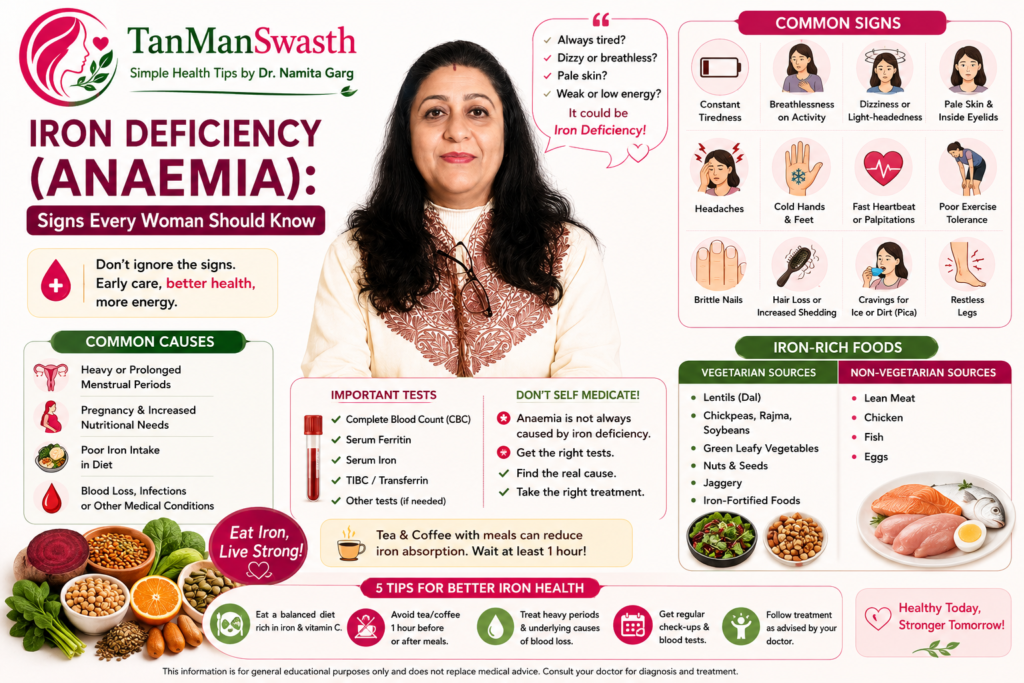
Are you constantly tired even after sleeping?
Do you feel dizzy when you stand up?
Do you get breathless while climbing stairs?
Are your periods very heavy?
Do you notice pale skin, headaches, cold hands or unusual weakness?
Many women simply blame these symptoms on stress, busy routines, poor sleep or getting older.
But sometimes the reason is much simpler—and very treatable:
Iron deficiency or iron-deficiency anaemia.
Anaemia is particularly common among women, especially those who menstruate and women during pregnancy. However, anaemia is not always caused by iron deficiency. Blood loss, nutritional deficiencies, infections, inflammation, chronic diseases and inherited blood disorders can also cause it.
That is why understanding the warning signs—and getting the right tests—is important.
First: Iron Deficiency Is Not Exactly the Same as Anaemia
These two terms are often used as though they mean the same thing.
They don’t.
Iron deficiency
This means your body’s iron stores are becoming too low.
Iron-deficiency anaemia
This means the iron deficiency has progressed enough to interfere with the production of haemoglobin and red blood cells, resulting in anaemia.
So a woman can have low iron stores before she develops obvious anaemia.
This is one reason symptoms should not simply be dismissed until the haemoglobin becomes very low.
Iron deficiency is the most common nutritional cause of anaemia, but anaemia itself has many possible causes.
Why Are Women More Vulnerable?
Women have some unique reasons for developing iron deficiency.
1. Menstrual Blood Loss
Every menstrual period involves some blood loss.
For women with normal periods, the body usually replaces this loss through diet and normal iron metabolism.
But if periods are very heavy, prolonged or frequent, iron loss can become significant.
This is one of the most important reasons a woman with iron-deficiency anaemia should be asked about her menstrual history.
Heavy menstrual bleeding is a recognized cause of anaemia.
2. Pregnancy
During pregnancy, the body’s iron requirements increase.
Iron is needed for increased blood production and for the developing baby and placenta.
Women who enter pregnancy with low iron stores may therefore be particularly vulnerable to iron deficiency.
This is why iron status and anaemia are important parts of appropriate pregnancy care.
3. Diet
A diet that provides too little absorbable iron can contribute to iron deficiency.
This can happen with inadequate overall nutrition, restrictive diets or poorly planned vegetarian diets.
But being vegetarian does not automatically mean you will become anaemic.
A well-planned vegetarian diet can provide iron through foods such as:
- Lentils
- Beans
- Chickpeas
- Soy foods
- Green leafy vegetables
- Nuts
- Seeds
- Iron-fortified foods
The key is dietary variety, adequate intake and good absorption.
The Early Signs Women Often Ignore
Iron deficiency and anaemia can develop gradually.
You may not suddenly become extremely weak.
Instead, your body may give you small clues.
Here are some of the common signs.
1. Constant Tiredness
This is probably the symptom women ignore most often.
You wake up and still feel tired.
You finish ordinary household work and feel exhausted.
You don’t have the energy you used to have.
You may think:
“I am just getting older.”
or:
“I have too much work.”
Fatigue is a common symptom of anaemia because haemoglobin is responsible for carrying oxygen to tissues.
Of course, tiredness has many possible causes.
But persistent unexplained fatigue deserves attention.
2. Breathlessness During Activity
Do you become unusually breathless while:
- Climbing stairs
- Walking quickly
- Carrying groceries
- Doing household work
- Exercising
Mild breathlessness can have many causes.
But when anaemia becomes significant, reduced oxygen-carrying capacity can contribute to shortness of breath, particularly during exertion.
If this is new or getting worse, don’t simply assume that you are “out of shape.”
3. Dizziness or Light-Headedness
Some women describe it as:
“I feel like my head is floating.”
Others notice dizziness when standing up quickly.
Anaemia can cause dizziness or light-headedness.
But dizziness can also result from dehydration, low blood pressure, medication effects, low blood glucose and many other conditions.
So dizziness alone does not prove iron deficiency.
It is one piece of the puzzle.
4. Headaches
Frequent headaches can occur with anaemia.
But headaches have an enormous number of possible causes.
Poor sleep, dehydration, migraine, stress, vision problems and many other conditions can cause them.
So don’t start iron tablets simply because you have headaches.
If headaches are persistent or unexplained, get the underlying cause evaluated.
5. Pale Skin or Pale Inside the Eyelids
Some people with anaemia may look paler than usual.
The inside of the lower eyelid, gums or other mucous membranes may also appear pale.
However, skin colour varies naturally between individuals.
So looking pale is not a reliable way to diagnose anaemia.
A blood test is much more useful.
6. Cold Hands and Feet
Some people with iron-deficiency anaemia report feeling unusually cold, particularly in their hands and feet.
But this symptom is not specific to anaemia.
Thyroid problems, circulation issues, low body weight and other conditions can also cause cold hands and feet.
Again:
symptom ≠ diagnosis.
7. Fast Heartbeat or Awareness of Your Heartbeat
When the body has reduced oxygen-carrying capacity, the heart may work harder to deliver oxygen to tissues.
Some people may therefore notice a faster heartbeat or palpitations, particularly when anaemia is more significant.
If you have new or persistent palpitations, don’t assume that they are due to iron deficiency.
They deserve proper medical evaluation.
8. Poor Exercise Tolerance
You used to walk for 30 minutes.
Now 10–15 minutes feels exhausting.
You may notice that ordinary physical activity has become harder.
This can happen with anaemia because the body’s ability to transport oxygen is reduced.
But poor exercise tolerance can also be caused by heart, lung, thyroid, nutritional or other health problems.
So this is another reason to investigate rather than self-treat.
9. Brittle Nails
Some women with iron deficiency notice changes in their nails.
They may become brittle or fragile.
In more marked cases, the nails can become unusually shaped.
But nail changes can have many causes, including nutritional deficiencies and other medical conditions.
Don’t use nail appearance alone to diagnose iron deficiency.
10. Hair Loss or Increased Hair Shedding
This is a particularly worrying symptom for many women.
Iron deficiency can be associated with hair shedding, but hair loss is not specific to iron deficiency.
Other possibilities include:
- Thyroid problems
- Hormonal changes
- PCOS
- Post-pregnancy changes
- Stress
- Rapid weight loss
- Nutritional deficiencies
- Certain medications
- Other scalp conditions
If hair loss is significant or persistent, it is better to investigate the cause rather than automatically taking iron.
11. Unusual Cravings: Pica
One of the more unusual signs associated with iron deficiency is pica.
This means having cravings for substances that are not normally considered food.
Examples can include:
- Ice
- Clay
- Soil
- Chalk
- Paper
A strong craving to chew ice is sometimes called pagophagia.
If you develop unusual cravings like these, tell your doctor.
They can be an important clue to iron deficiency.
12. Restless Legs
Some people with iron deficiency experience uncomfortable sensations in the legs and an urge to move them, particularly at rest.
This can be associated with restless legs syndrome.
But restless legs have several possible causes, so appropriate evaluation is important.
Heavy Periods: A Warning Sign You Should Not Ignore
This deserves its own section.
If your periods are extremely heavy, iron tablets alone may not solve the problem.
You need to ask:
Why am I losing so much blood?
Heavy menstrual bleeding can occur because of conditions such as:
- Fibroids
- Adenomyosis
- Hormonal disorders
- Endometriosis
- Bleeding disorders
- Certain medications
- Other gynaecological conditions
Repeated heavy blood loss can gradually deplete iron stores.
So if you repeatedly develop low haemoglobin or low iron, the underlying cause of blood loss needs attention. WHO specifically identifies heavy menstrual loss as an important contributor to anaemia in women.
What Does a Heavy Period Actually Mean?
Every woman’s period is different.
Some bleeding is normal.
But speak with a healthcare professional if your periods are unusually heavy, last much longer than expected, repeatedly interfere with normal activities, or are associated with dizziness, weakness or symptoms of anaemia.
Don’t accept:
“All women have heavy periods.”
as an explanation.
Very heavy bleeding deserves evaluation.
How Is Iron-Deficiency Anaemia Diagnosed?
You cannot reliably diagnose iron deficiency just by looking at symptoms.
Your doctor may start with a complete blood count (CBC).
This can provide information about:
- Haemoglobin
- Red blood cell count
- Haematocrit
- Red blood cell size and other indices
If iron deficiency is suspected, your doctor may also consider tests such as:
- Ferritin
- Serum iron
- Transferrin or iron-binding measures
- Other tests depending on the situation
Ferritin is particularly useful for assessing iron stores, although its interpretation can be affected by inflammation and other conditions.
The appropriate tests depend on your symptoms and medical history.
Why Ferritin Matters
Imagine your haemoglobin is still within the normal range, but your iron stores are already becoming depleted.
A ferritin test can help assess your body’s stored iron.
This is why a woman with fatigue should not automatically ask only:
“What is my haemoglobin?”
A doctor may need to consider the complete picture.
And remember:
Low haemoglobin does not automatically mean iron deficiency.
There are many other causes of anaemia.
Not Every Anaemia Is Iron Deficiency
This is a very important medical point.
Anaemia can result from:
- Iron deficiency
- Vitamin B12 deficiency
- Folate deficiency
- Chronic inflammation
- Kidney disease
- Infections
- Blood loss
- Inherited conditions such as thalassaemia
- Other medical conditions
So if your haemoglobin is low, the correct question is:
“Why is my haemoglobin low?”
—not simply:
“Which iron tablet should I take?”
WHO emphasizes that anaemia has multiple causes and that identifying the underlying cause is important.
What Should You Eat to Improve Iron Intake?
A balanced diet can help prevent iron deficiency and support treatment when combined with appropriate medical care.
Vegetarian Sources
Useful sources include:
- Lentils
- Chickpeas
- Rajma
- Soybeans and soy foods
- Peas
- Green leafy vegetables
- Sesame seeds
- Pumpkin seeds
- Nuts
- Iron-fortified foods
Non-Vegetarian Sources
Depending on dietary preference:
- Lean meat
- Poultry
- Fish
- Shellfish
The body generally absorbs iron from animal foods more efficiently than the non-haem iron found in plant foods.
But a well-planned vegetarian diet can still provide adequate iron.
Add Vitamin C to Your Meal
Vitamin C can improve absorption of non-haem iron from plant foods.
So consider combining iron-containing foods with vitamin-C-rich foods such as:
- Amla
- Guava
- Oranges
- Lemon
- Tomatoes
- Capsicum
- Other fruits and vegetables rich in vitamin C
For example:
Dal + vegetables + lemon
can be a simple combination.
You don’t need an expensive “iron tonic” to make every meal healthier.
Tea and Coffee Can Interfere With Iron Absorption
This is especially relevant in India, where tea and coffee are part of many people’s daily routines.
Tea and coffee contain compounds that can reduce absorption of non-haem iron when consumed with iron-rich meals.
WHO advises avoiding tea and coffee around iron-rich meals and notes that calcium can also interfere with iron absorption.
So instead of having:
Iron-rich meal + tea immediately afterward
consider separating them.
This small habit can make your diet more supportive of iron absorption.
Should Every Woman Take Iron Tablets?
No.
This is a very important point.
Iron supplements are useful when iron deficiency is present or when supplementation is medically recommended.
But taking iron unnecessarily is not harmless.
Excess iron can accumulate and cause harm, and some anaemias are not caused by iron deficiency at all.
So don’t start iron simply because:
- You feel tired
- Your friend takes it
- Your hair is falling
- Someone on social media recommends it
- You are a woman
The right approach is:
Symptoms → evaluation → appropriate testing → correct treatment.
What Happens When You Take Iron?
When iron deficiency is confirmed, your doctor may recommend oral iron.
Some people experience side effects such as:
- Constipation
- Nausea
- Stomach discomfort
- Metallic taste
- Dark stools
These side effects can make some women stop treatment.
If this happens, don’t simply abandon the treatment.
Speak with your doctor.
Different formulations, doses or schedules may sometimes be considered depending on the individual situation. WHO also recognizes that side effects can affect adherence to iron supplementation.
How Long Does Treatment Take?
Treatment is not always a matter of taking iron for a few days.
Restoring iron stores can take months, depending on how severe the deficiency is and whether the cause of iron loss has been addressed.
NHLBI notes that oral iron is a common treatment for iron-deficiency anaemia and that restoring iron levels can take several months.
This is why follow-up blood tests may be needed.
The goal is not simply:
“My haemoglobin became normal.”
The goal is also to understand whether the underlying iron deficiency has been corrected and whether the cause of the deficiency has been addressed.
What If Iron Tablets Don’t Work?
If your haemoglobin or iron status does not improve as expected, your doctor may need to investigate:
- Whether the diagnosis was correct
- Whether the prescribed treatment is being taken consistently
- Whether absorption is impaired
- Whether there is ongoing blood loss
- Whether another medical condition is present
- Whether another type of anaemia is responsible
In selected situations, intravenous iron may be considered.
But this decision should be made by a healthcare professional.
Iron Deficiency and Weight Loss
This is particularly important for women following restrictive diets.
If you are trying to lose weight, don’t make your diet so restrictive that you stop getting enough iron, protein and other essential nutrients.
A good weight-loss plan should still include:
adequate protein + vegetables + fibre + appropriate carbohydrates + healthy fats + essential micronutrients.
Crash diets may reduce your weight quickly, but they are not a good long-term strategy for health.
Iron Deficiency and Pregnancy
Pregnancy increases the body’s nutritional demands.
Women planning pregnancy should discuss appropriate nutrition and prenatal supplementation with their healthcare professional.
If you already have anaemia or low iron before pregnancy, it is particularly important to address it rather than waiting until pregnancy progresses.
WHO highlights anaemia as an important concern in pregnant women and recognizes iron deficiency as a major contributor.
When Should You See a Doctor Quickly?
Seek medical attention promptly if you have:
- Severe breathlessness
- Chest pain
- Fainting
- A very rapid or irregular heartbeat
- Heavy ongoing bleeding
- Black or bloody stools
- Severe weakness
- Significant dizziness
Severe anaemia can place considerable strain on the body and should not be managed at home with dietary changes alone.
A Simple Iron-Friendly Indian Plate
A practical meal might look like:
Breakfast
Eggs or another protein source + whole-grain food + fruit
Lunch
Dal/beans + vegetables + roti or another suitable carbohydrate + salad with lemon
Snack
Fruit + a sensible portion of nuts or seeds
Dinner
Vegetables + protein source + appropriate carbohydrate portion
The exact quantities depend on your age, weight, activity level, medical conditions and nutritional needs.
The goal is balanced nutrition, not simply eating as much iron-rich food as possible.
Five Mistakes Women Should Avoid
Mistake 1: Blaming Everything on Stress
Constant fatigue deserves evaluation.
Mistake 2: Taking Iron Without Testing
Not every anaemia is caused by iron deficiency.
Mistake 3: Ignoring Heavy Periods
Replacing lost iron without treating excessive blood loss may allow the problem to keep returning.
Mistake 4: Drinking Tea Immediately With Meals
This can reduce absorption of non-haem iron.
Mistake 5: Stopping Treatment Too Early
Iron stores may take longer to recover than symptoms.
The TanManSwasth Doctor’s Takeaway
Feeling tired all the time is not something you should simply accept because you are a woman.
Your body may be telling you that something needs attention.
Iron deficiency and anaemia are common, particularly among menstruating women and during pregnancy, but they should not be diagnosed by symptoms alone.
If you have:
persistent fatigue + dizziness + breathlessness + heavy periods + pale skin + poor exercise tolerance
it is worth discussing the symptoms with your healthcare professional.
A simple blood test can often provide important clues.
And remember the most important lesson:
Don’t just treat the low haemoglobin. Find out why it became low.
If the cause is heavy menstrual bleeding, address the bleeding.
If the cause is poor dietary intake, improve nutrition.
If there is another medical condition, treat the underlying condition.
If iron deficiency is confirmed, use appropriate iron treatment under medical guidance.
Your energy, concentration, physical strength and overall quality of life matter.
Don’t spend months telling yourself, “I’m just tired.”
Find out why.
Important Medical Note
This article is for general health education and does not replace individual medical diagnosis or treatment. Anaemia has many possible causes, and iron supplements should not be taken routinely without appropriate medical advice. If you have persistent symptoms, heavy menstrual bleeding, pregnancy, unexplained weight loss, gastrointestinal symptoms or abnormal blood-test results, consult a qualified healthcare professional.