
Have you ever checked your weight and wondered whether it is healthy for your height?
Body Mass Index (BMI) is one simple measurement that can help give you an initial idea about your weight in relation to your height.
But BMI is not a complete health assessment. It is a screening tool, and your health professional may also consider your waist measurement, age, medical history, blood pressure, blood sugar and other factors.
1. What Is BMI?
BMI stands for Body Mass Index.
It is calculated using your weight and height:
BMI = Weight in kilograms ÷ Height in metres²
For example:
If a person weighs 70 kg and is 1.70 metres tall:
BMI = 70 ÷ (1.70 × 1.70) = 24.2
The resulting number is your BMI.
BMI can help healthcare professionals identify people who may have an increased health risk because of low or high body weight.
2. What Do the BMI Numbers Mean?
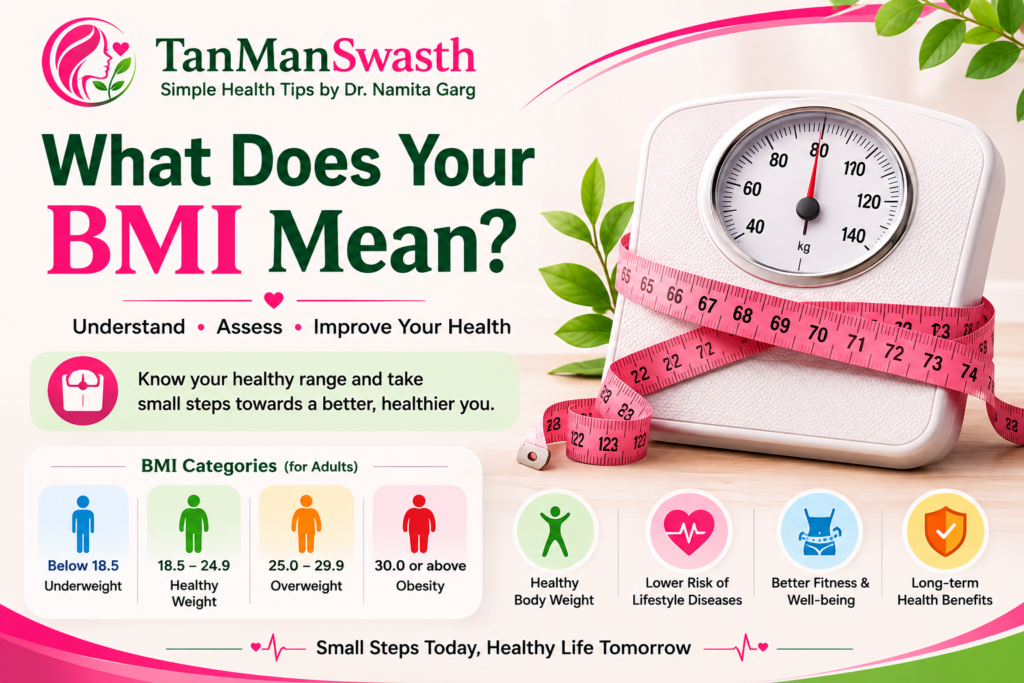
For most adults, the commonly used BMI categories are:
| BMI | Category |
|---|---|
| Below 18.5 | Underweight |
| 18.5 – 24.9 | Healthy weight |
| 25.0 – 29.9 | Overweight |
| 30.0 or above | Obesity |
These categories are useful for screening, but they should not be interpreted as a diagnosis by themselves.
A person’s health cannot be determined from one number alone.
3. Why Isn’t BMI the Whole Story?
BMI does not directly measure body fat.
For example, someone who has a lot of muscle may have a higher BMI even though they do not have excessive body fat.
BMI also does not show where fat is stored in the body.
This matters because excess fat around the abdomen can be associated with increased health risks.
That’s why healthcare professionals may look at other measurements along with BMI.
4. Why Is Waist Measurement Important?
Your waist measurement can provide additional information about health risk, particularly when there is excess abdominal fat.
A larger waist circumference can be associated with a higher risk of conditions such as:
- Type 2 diabetes
- High blood pressure
- Heart disease
- Metabolic problems
For this reason, BMI and waist circumference can provide more useful information together than BMI alone.
However, waist measurements also need to be interpreted appropriately, and cut-offs can differ between populations.
5. What Should You Do If Your BMI Is High?
Don’t panic — and don’t start an extreme diet just because you see a higher BMI number.
Instead, look at the bigger picture.
Ask yourself:
- Is my waist measurement increasing?
- Am I physically active?
- What does my usual diet look like?
- Am I sleeping well?
- Do I have high blood pressure or blood sugar?
- Has my weight changed recently?
- Am I taking any medicines that may affect my weight?
If you are concerned about your BMI or weight, discuss it with a qualified healthcare professional.
BMI is a starting point for understanding your health — not a final verdict.
6. BMI and Asian Adults
BMI does not mean exactly the same thing for every population.
Research has shown that some Asian populations can have a higher percentage of body fat and increased metabolic risk at lower BMI levels compared with some other populations.
This is particularly important when considering conditions such as:
- Type 2 diabetes
- High blood pressure
- Heart disease
- Abdominal obesity
For this reason, a healthcare professional may consider additional measurements and risk factors when assessing an Asian adult.
Do not assume that a BMI below 25 automatically means that everything is healthy.
Your waist measurement, blood pressure, blood sugar, cholesterol, family history and lifestyle may also matter.
7. BMI and Older Adults
BMI also needs to be interpreted carefully as we get older.
With ageing, people can gradually lose muscle mass while gaining or redistributing body fat. This means that two people with exactly the same BMI can have different amounts of muscle and body fat.
For older adults, a healthcare professional may therefore consider:
- Weight changes over time
- Muscle strength
- Physical activity
- Waist circumference
- Nutrition
- Existing medical conditions
- Medicines
So don’t judge your health only by the number on your weighing scale.
8. What Is a Healthy BMI?
For most adults, a BMI between 18.5 and 24.9 falls within the commonly used healthy-weight range.
But remember:
Healthy BMI does not automatically mean perfect health.
A person can have a BMI within this range and still have:
- High blood pressure
- High blood sugar
- High cholesterol
- Low fitness
- Excess abdominal fat
- Poor dietary habits
Likewise, a person with a BMI outside the usual range should not be judged by BMI alone.
Think of BMI as a screening signal, not a complete health report.
9. Frequently Asked Questions About BMI
Is BMI the same for men and women?
The standard adult BMI calculation is the same for men and women.
However, men and women can have different amounts and distributions of body fat at the same BMI. Other health measurements may therefore be useful.
Can I calculate my BMI at home?
Yes.
You only need your weight and height.
BMI = Weight (kg) ÷ Height (m)²
For example:
60 kg ÷ (1.65 × 1.65) = BMI 22.0
You can calculate it yourself, but remember that the result is only one part of your health assessment.
Does a high BMI always mean I am unhealthy?
No.
BMI does not directly measure body fat and can be misleading in people with high muscle mass or different body compositions.
Does a normal BMI mean I don’t need to worry about my health?
Not necessarily.
Your blood pressure, blood sugar, cholesterol, waist circumference, activity level, diet and family history can all be important.
Should children use the adult BMI table?
No.
BMI interpretation for children and teenagers is different because their body composition changes with age and sex. Adult BMI categories should not simply be applied to children.
10. Your BMI Is a Starting Point — Not a Verdict
BMI can be a useful first step in understanding your weight.
But your health is much more than a number.
If your BMI is higher or lower than the usual range, don’t panic and don’t immediately turn to an extreme diet.
Instead, look at the complete picture:
Eat a balanced diet.
Stay physically active.
Maintain a healthy waist size.
Get adequate sleep.
Monitor important health measurements.
Have regular health check-ups.
And if you are concerned about your weight, blood sugar, blood pressure or other health issues, speak with a qualified healthcare professional.
The Bottom Line
BMI can tell you something about your weight — but it cannot tell you everything about your health.
Use it as a starting point, understand what it means, and look at the bigger picture.
Medical Disclaimer
This article is intended for general health education and does not replace individual medical advice, diagnosis or treatment.
BMI is a screening measure and should be interpreted in the context of an individual’s overall health. If you have concerns about your weight, waist measurement, blood sugar, blood pressure or other health conditions, consult a qualified healthcare professional.
Sources
- World Health Organization — BMI and adult weight classification.
- World Health Organization — BMI and health-risk indicators.
- WHO Expert Consultation — BMI and Asian populations.