
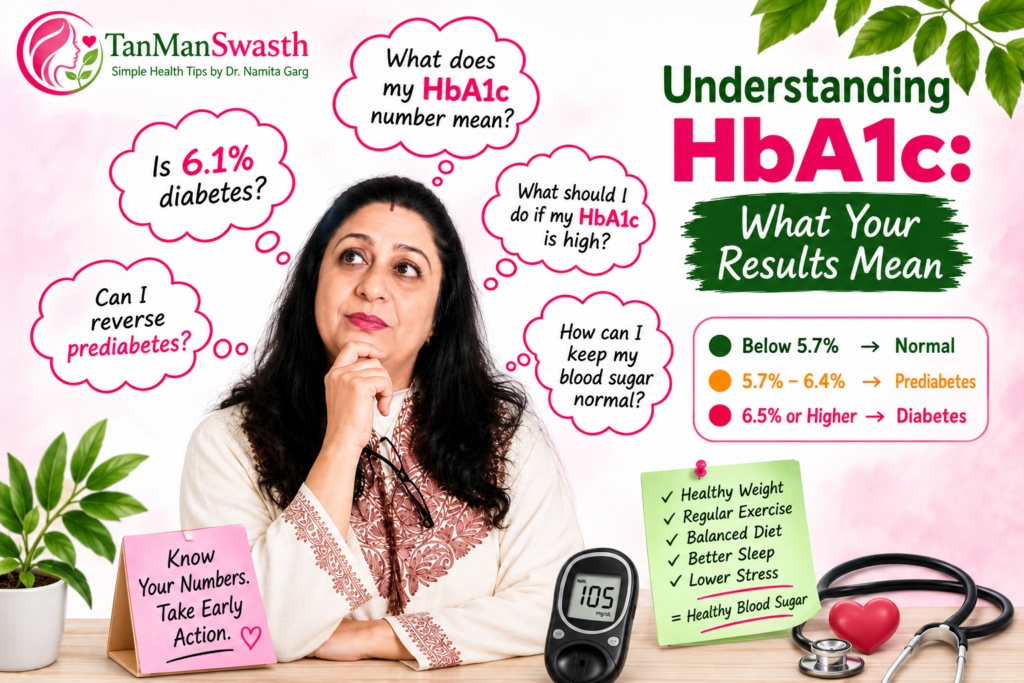
“Doctor, my HbA1c is 6.1%. Is that diabetes?”
This is one of the most common questions people ask after receiving a blood-test report.
And the answer is important:
An HbA1c number should never be looked at in isolation.
It tells us something very useful about your blood glucose over the previous few months, but understanding what that number means requires looking at the whole picture—your fasting glucose, weight, waist circumference, lifestyle, medications, family history and other health factors.
For women concerned about weight gain, belly fat, prediabetes or diabetes prevention, HbA1c can be an especially useful health marker.
So let’s understand it properly.
What Is HbA1c?
HbA1c is a blood test that reflects your average blood glucose over approximately the previous 3 months.
It is also called:
- A1c
- HbA1c
- Glycated haemoglobin
- Glycosylated haemoglobin
Glucose in your bloodstream attaches to haemoglobin inside red blood cells.
When blood glucose remains higher, more glucose becomes attached to haemoglobin.
The HbA1c test measures this percentage.
That is why:
Higher HbA1c generally means higher average blood glucose.
Why Is HbA1c So Useful?
A fasting blood glucose test gives you a snapshot.
For example:
You may have a fasting glucose of 98 mg/dL on Monday morning.
That tells us what your glucose was around that particular time.
But what happened during the previous weeks?
Did your glucose rise after meals?
Was it frequently elevated in the evening?
Was it normal most of the time?
A single fasting reading cannot answer all of those questions.
HbA1c gives us a much broader view because it reflects glucose exposure over several weeks.
That makes it particularly useful for detecting patterns that a single glucose reading may miss.
What Does Your HbA1c Number Mean?
For non-pregnant adults, current ADA criteria classify HbA1c broadly as follows:
| HbA1c | What It Generally Means |
|---|---|
| Below 5.7% | Normal range |
| 5.7%–6.4% | Prediabetes range |
| 6.5% or higher | Diabetes range |
An HbA1c of 6.5% or higher is one of the diagnostic criteria for diabetes, but diagnosis generally needs appropriate confirmation unless there is clear evidence of hyperglycemia.
So:
5.4% ≠ prediabetes
5.9% = prediabetes range
6.2% = prediabetes range
6.5% or above = diabetes range, requiring medical evaluation/confirmation
Don’t diagnose yourself from one report.
HbA1c Below 5.7%
If your HbA1c is below 5.7%, that is generally considered within the normal range for adults.
For example:
HbA1c = 5.3%
This does not mean that you can completely forget about your health.
Your future risk also depends on factors such as:
- Family history
- Body weight
- Waist circumference
- Physical activity
- Blood pressure
- Cholesterol
- Diet
- Age
- Previous gestational diabetes
- PCOS
A normal HbA1c today is encouraging, but healthy habits are still important.
HbA1c Between 5.7% and 6.4%
This is the range that often causes confusion.
An HbA1c between 5.7% and 6.4% is in the prediabetes range.
For example:
HbA1c 5.7%
This is the lower end of the prediabetes range.
HbA1c 6.0%
This deserves attention and lifestyle intervention, particularly when other risk factors are present.
HbA1c 6.4%
This is very close to the diabetes diagnostic threshold.
But remember:
Prediabetes does not mean you definitely have diabetes.
It means your glucose regulation is outside the normal range and your risk of developing type 2 diabetes is increased.
This is exactly why early action matters.
HbA1c of 6.5% or Higher
An HbA1c of 6.5% or higher meets one of the laboratory criteria used to diagnose diabetes in non-pregnant adults.
But please don’t look at the number and immediately conclude:
“I have diabetes.”
Your doctor may repeat the test or use another glucose test to confirm the diagnosis, depending on the circumstances.
The diagnosis should be made using an appropriate laboratory test and clinical context.
HbA1c Is an Average—And Averages Can Hide Things
This is one of the most important things to understand.
Suppose two people have a similar HbA1c.
Their daily glucose patterns may still be quite different.
One person may have relatively stable glucose throughout the day.
Another may have:
- Lower fasting glucose
- Large rises after meals
- High evening glucose
- Significant day-to-day variation
Their average could look similar even though their glucose patterns are different.
That’s why HbA1c should not completely replace glucose monitoring when glucose monitoring is clinically appropriate.
HbA1c tells you the big picture.
Other glucose measurements can help explain the details.
Can You Convert HbA1c Into an Average Blood Sugar?
HbA1c can be translated into an estimated average glucose (eAG).
Approximate examples are:
| HbA1c | Approx. Average Glucose |
| 5.0% | ~97 mg/dL |
| 5.5% | ~111 mg/dL |
| 6.0% | ~126 mg/dL |
| 6.5% | ~140 mg/dL |
| 7.0% | ~154 mg/dL |
| 8.0% | ~183 mg/dL |
| 9.0% | ~212 mg/dL |
These are estimated averages, not targets.
And an important point:
Your HbA1c-derived average will not exactly match the individual readings you see on a glucose meter.
That’s because a meter shows glucose at specific moments, while HbA1c reflects a longer-term average.
Why Your HbA1c May Not Match Your Glucose Meter
This is a very common source of confusion.
Imagine someone checks their glucose regularly and usually sees:
90–130 mg/dL
but their HbA1c seems higher than expected.
Or another person has an HbA1c that looks relatively good even though they occasionally see very high glucose readings.
Why can this happen?
Because HbA1c is an average.
It does not show every glucose spike.
It also does not tell you exactly when the glucose was high.
There can also be medical factors that make HbA1c less reliable.
When Can HbA1c Be Less Reliable?
HbA1c depends on normal red blood cell biology.
Conditions that affect red blood cells or haemoglobin can sometimes interfere with the result.
Examples include certain:
- Anaemias
- Haemoglobin variants
- Conditions affecting red blood cell turnover
- Blood disorders
- Certain medical treatments
Some haemoglobin variants are more common in certain populations, including parts of South and Southeast Asia.
If your HbA1c doesn’t seem to match your glucose readings, tell your doctor.
The doctor may decide that another test is more appropriate.
Does HbA1c Require Fasting?
No.
Unlike a fasting blood glucose test, an HbA1c test can generally be performed without fasting.
You can usually have your blood sample taken at any time of day.
However, if your doctor orders HbA1c together with a fasting glucose or lipid profile, you may still need to follow fasting instructions for those other tests.
So always follow the instructions given by your laboratory or doctor.
HbA1c and Weight Management
This is where HbA1c becomes particularly interesting for the TanManSwasth audience.
If you are trying to lose weight, don’t look only at kilograms.
Look at:
Weight + Waist + HbA1c + Blood Glucose
For example, imagine a woman loses 4 kg over several months.
Her weight has improved.
But perhaps her waist has also reduced and her HbA1c has moved from:
6.1% → 5.7%
That gives us much more information than the weighing scale alone.
It suggests that her overall metabolic health may be improving.
The reverse can also happen.
Someone may remain at approximately the same weight but become less active, gain abdominal fat and see HbA1c gradually increase.
That’s why metabolic health matters as much as body weight.
Belly Fat and HbA1c: Why They Often Appear Together
Belly fat deserves special attention.
Excess abdominal or visceral fat is associated with insulin resistance and increased risk of type 2 diabetes.
This does not mean:
“Belly fat = diabetes.”
It means that increasing abdominal fat can be one piece of a larger metabolic-risk picture.
If your waistline is increasing and your HbA1c is also moving upward, it is worth discussing the combination with your doctor.
The ADA specifically identifies abdominal/visceral obesity and insulin-resistance-associated conditions among factors associated with prediabetes.
What If Your HbA1c Is 5.8%?
Let’s take a practical example.
Suppose your report says:
HbA1c = 5.8%
You might think:
“It’s only 0.1 above normal, so I don’t need to worry.”
That is not the best approach.
It is not a reason to panic either.
Instead, ask:
- Has my weight increased?
- Has my waist increased?
- Am I physically active?
- Do I have a family history of diabetes?
- Do I have PCOS?
- Did I have gestational diabetes?
- What does my fasting glucose show?
- How is my diet?
- How much processed food and sugary food do I consume?
The number becomes much more meaningful when viewed in context.
What If Your HbA1c Is 6.1%?
An HbA1c of 6.1% falls within the prediabetes range.
This is a very good time to act.
Don’t wait until it reaches 6.5%.
Instead, focus on the fundamentals:
Reduce excess weight if appropriate
Even modest weight loss can improve metabolic health.
Increase physical activity
Build toward regular moderate-intensity activity.
Improve food quality
Increase vegetables, legumes, fibre-rich foods and minimally processed foods.
Control portions
Healthy food can still contribute excess calories when portions are very large.
Reduce sugary drinks and highly processed snacks
These are easy places to reduce unnecessary calories and added sugars.
Follow up with your doctor
Your doctor can decide when your HbA1c should be repeated and whether additional tests are needed.
People with prediabetes should generally have diabetes testing at least annually under current ADA guidance.
What If Your HbA1c Is 6.4%?
An HbA1c of 6.4% is still in the prediabetes range.
But it is very close to the diabetes threshold.
This is not the time for:
“Let’s see what happens next year.”
It is the time to take prevention seriously.
Your doctor may evaluate:
- Fasting glucose
- Repeat HbA1c
- Other glucose testing where appropriate
- Blood pressure
- Lipids
- Weight and waist
- Other diabetes risk factors
And most importantly, you should have a clear prevention plan.
What Does HbA1c Tell You If You Already Have Diabetes?
Once diabetes has been diagnosed, HbA1c becomes an important tool for monitoring long-term glucose control.
For many non-pregnant adults with diabetes, an HbA1c target around below 7% is commonly used.
But this is not a universal target.
The right target can be different depending on:
- Age
- Duration of diabetes
- Medications
- Risk of hypoglycaemia
- Other medical conditions
- Diabetes complications
- Individual circumstances
So please don’t compare your HbA1c target with someone else’s.
Your diabetes target should be individualised with your healthcare professional.
HbA1c Is Not a Report Card on Your Willpower
This is something I would especially like women to remember.
If your HbA1c increases, don’t immediately think:
“I failed.”
Blood glucose is influenced by many factors.
Food and exercise matter, but so do:
- Genetics
- Age
- Insulin resistance
- Illness
- Medications
- Sleep
- Stress
- Hormonal factors
- Duration of diabetes
The correct response to an unexpected result is not guilt.
It is:
Understand → investigate → adjust → follow up.
Three Numbers You Should Know
If you are concerned about diabetes or weight-related metabolic health, I encourage you to know these three numbers:
1. Your Weight
Not because weight determines your health—but because changes over time can provide useful information.
2. Your Waist Circumference
Especially when abdominal fat is increasing.
3. Your HbA1c
Because it provides a longer-term picture of blood glucose.
Together, these can give a much better picture than the weighing scale alone.
How Often Should HbA1c Be Checked?
There is no single schedule that is correct for everyone.
For people with prediabetes, current ADA guidance recommends testing at least yearly. For people with normal results, screening at least every three years may be reasonable, with more frequent testing depending on risk. People with diabetes may need HbA1c testing more frequently depending on their treatment and whether they are meeting their goals.
Your doctor should determine the appropriate interval for you.
Don’t Chase a “Perfect” HbA1c
This is another common mistake.
People sometimes become obsessed with getting their HbA1c as low as possible.
Lower is not automatically better for everyone.
For someone taking glucose-lowering medication, pushing glucose too low can increase the risk of hypoglycaemia.
The goal is not to achieve the smallest possible HbA1c.
The goal is:
Safe + sustainable + appropriate glucose control.
Your target should be individualised.
The TanManSwasth Doctor’s Guide to Reading Your HbA1c
When you receive your next report, don’t just look at the number.
Ask these questions:
“What is my HbA1c?”
Then:
“Which category does it fall into?”
Then:
“What does my fasting glucose show?”
Then:
“Has my weight or waist changed?”
Then:
“What are my diabetes risk factors?”
And finally:
“What should I do next?”
That turns a laboratory number into a health plan.
The Bottom Line
HbA1c is one of the most useful numbers for understanding your long-term blood glucose—but it is not the whole story.
Remember these ranges for non-pregnant adults:
Below 5.7% → generally normal
5.7%–6.4% → prediabetes range
6.5% or above → diabetes range, requiring medical evaluation and appropriate confirmation
If your HbA1c is in the prediabetes range, don’t panic and don’t ignore it.
It is an opportunity to act early.
Improve your food pattern.
Move your body regularly.
Work toward a healthy weight if needed.
Reduce excess abdominal fat.
Get adequate sleep.
Know your numbers.
And stay in touch with your doctor.
Your HbA1c is not just a number on a report.
It is a window into what your blood glucose has been doing over the past few months—and sometimes, that window gives you an opportunity to change the direction of your health.
Important Medical Note
This article is for general health education and does not replace individual medical diagnosis or treatment. HbA1c interpretation can be affected by pregnancy, certain anaemias, haemoglobin variants and other conditions. If your HbA1c result is abnormal or does not match your home glucose readings, discuss the result with your healthcare professional rather than interpreting it on your own.