
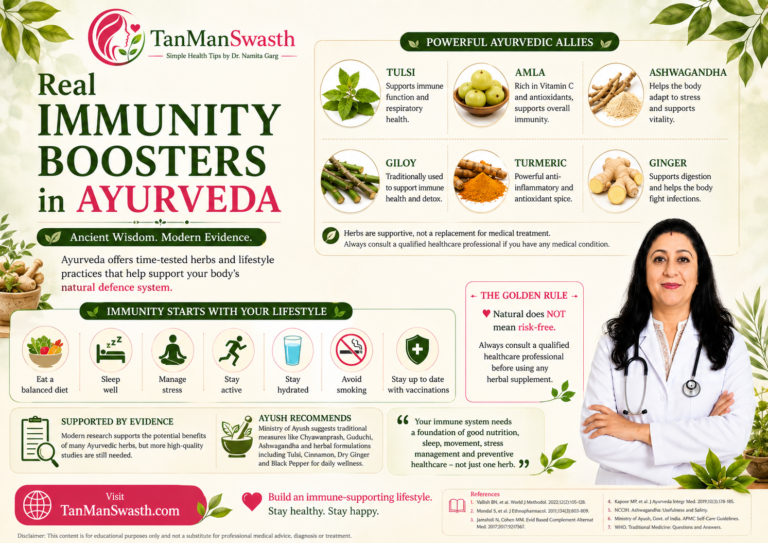
Can Ayurveda really help support your immunity?
The answer is yes—but not in the way social media often makes it sound.
There is no single Ayurvedic herb that can magically “boost your immunity” overnight.
Your immune system is a complex network involving cells, tissues, organs, nutrition, sleep, stress, physical activity, and many other factors.
Ayurveda has traditionally used Rasayana—approaches intended to support health, vitality and resilience—and several medicinal plants have been studied for their effects on immune and inflammatory pathways.
But there is an important difference between:
“This herb may support certain immune functions”
and
“This herb will prevent every infection.”
The first statement may be supported by research in some cases.
The second is simply an overclaim.
So, let’s look at some of the better-known Ayurvedic choices.
🌿 1. Tulsi — The Traditional Immune-Supporting Herb
Tulsi (Ocimum sanctum / Ocimum tenuiflorum) has been used in Indian traditional medicine for centuries.
It is commonly consumed as fresh leaves, tea or as part of herbal preparations.
Interestingly, Tulsi has also been studied in human volunteers.
In a double-blind randomized controlled trial, healthy volunteers who received Tulsi leaf extract for four weeks showed changes in several immune-related measurements, including T-helper cells and natural killer (NK) cells.
A systematic review of human studies also found evidence suggesting potential benefits of Tulsi across several areas, including immune-related outcomes, although the overall evidence base remains limited.
💚 The practical takeaway
Tulsi can be a sensible traditional addition to a healthy diet, such as Tulsi tea, but it should not be considered a substitute for vaccination, medical treatment, good nutrition or adequate sleep.
🟠 2. Amla — Ayurveda’s Vitamin-C-Rich Fruit
Amla (Emblica officinalis / Phyllanthus emblica) is one of the most famous fruits in Ayurveda.
It is traditionally valued as a Rasayana and is commonly included in Ayurvedic preparations such as Chyawanprash.
Amla is rich in antioxidant compounds, and human research has examined its effects on oxidative stress, inflammation and metabolic health.
One randomized, double-blind, placebo-controlled crossover study in healthy adults found that daily amla supplementation was associated with improvements in several cardiovascular and oxidative-stress-related markers.
However, we should be precise:
⚠️ Amla is not a proven “infection shield.”
The evidence is stronger for its nutritional and antioxidant properties than for claiming that eating amla prevents infections.
🍈 The practical takeaway
Fresh amla, unsweetened amla preparations, or amla as part of a balanced diet can be a nutritious choice.
For people with diabetes, avoid assuming that every amla candy, juice or preparation is healthy—some products contain considerable added sugar.
🌱 3. Ashwagandha — More Than an “Immunity Herb”
Ashwagandha (Withania somnifera) is one of Ayurveda’s best-known Rasayana herbs.
It has attracted considerable modern research, particularly around stress and sleep.
This is important because immunity is not isolated from the rest of the body.
Poor sleep and chronic stress can affect overall health and immune function.
However, claims that Ashwagandha is a universal immunity booster go beyond the available evidence.
The U.S. National Center for Complementary and Integrative Health notes that some Ashwagandha preparations may help with stress and insomnia, but evidence for many other health conditions remains insufficient.
⚠️ And natural does not automatically mean safe.
Ashwagandha can cause stomach upset or drowsiness and has been linked, rarely, with liver injury. It can also interact with medicines, including some medicines used for diabetes, blood pressure, thyroid conditions and immune suppression.
🌿 The practical takeaway
Ashwagandha should be considered a specific herbal supplement with potential benefits—not a daily immunity pill for everyone.
If you take regular medicines, talk to your healthcare professional before using it.
🌿 4. Giloy — Popular, But Handle With Care
Giloy (Tinospora cordifolia) is another well-known Ayurvedic plant traditionally associated with immune support.
There is laboratory, animal and some human research investigating its immunomodulatory effects. A review of the available literature describes several potential immune-related mechanisms.
However, this is exactly where we need to be careful.
❌ “Traditional use” does not automatically equal “proven treatment.”
Research on Giloy is still developing, and the evidence does not justify telling everyone to take it routinely for immunity.
There have also been reports of liver injury associated with Tinospora cordifolia, making unsupervised use particularly concerning.
🚨 Our message at TanManSwasth:
Do not take Giloy simply because someone on social media says it is an immunity booster.
If you want to use it, discuss it with a qualified healthcare professional—especially if you already have a medical condition or take medicines.
🟡 5. Turmeric — A Powerful Spice, Not a Miracle Medicine
Most Indian kitchens already contain one traditional ingredient with enormous scientific interest:
Haldi (turmeric).
Its best-known active compound is curcumin.
Curcumin has been investigated extensively for its effects on inflammation and oxidative stress.
A large 2024 systematic review and meta-analysis included 103 randomized controlled trials involving 7,216 participants and found that curcumin supplementation affected several health outcomes, including some inflammatory and oxidative-stress markers. However, the certainty of evidence varied considerably between outcomes.
That doesn’t mean:
“Take turmeric and you won’t get sick.”
It means turmeric and curcumin are biologically active substances that have been studied—and some effects are promising.
🥘 The practical takeaway
Using turmeric as a normal culinary spice is a simple way to include it in your diet.
But high-dose curcumin supplements are different from ordinary cooking amounts and may interact with medicines or be inappropriate for some people.
🍵 6. Ginger — Simple, Traditional and Useful
Ginger (Shunthi/Ardraka) has been part of Indian food and traditional medicine for generations.
It contains several biologically active compounds and is commonly used in food and beverages.
Interestingly, one human study investigated an Ayurvedic-herb tea containing Ashwagandha, liquorice, ginger, Tulsi and cardamom and found increased NK-cell activity compared with regular tea in older healthy volunteers.
But remember:
This was a combination of herbs.
We cannot automatically say that ginger alone produced the effect.
This is an important lesson when reading herbal research.
🌿 So What Is the REAL Ayurvedic Immunity Booster?
Here is the part that is often missing from social-media posts.
Your strongest “immunity booster” is not a bottle.
It is your daily lifestyle.
Ayurvedic health philosophy has traditionally placed importance on food, routine, sleep, activity, digestion, mental balance and prevention.
Modern medicine also recognizes that overall health strongly depends on these foundations.
So instead of searching for one magical herb, build your foundation:
🥗 Eat a diverse diet
Include vegetables, fruits, pulses, whole grains, nuts, seeds and adequate protein.
😴 Sleep properly
Good sleep is not a luxury. It is part of maintaining healthy body function.
🚶 Stay physically active
Regular physical activity supports overall metabolic and cardiovascular health.
💧 Stay hydrated
Drink an appropriate amount of fluid for your needs.
🧘 Manage chronic stress
Meditation, yoga, breathing exercises, time outdoors and meaningful social connection can all be part of a healthy routine.
🚭 Avoid smoking
Smoking damages health and weakens the body’s ability to deal with disease.
💉 Keep vaccinations up to date
Herbs should never be promoted as a replacement for proven preventive measures such as vaccination.
🌿 What Does Ayurveda Officially Recommend?
The Ministry of Ayush has published Ayurvedic self-care guidance that includes traditional measures such as Chyawanprash, Guduchi, Ashwagandha and an AYUSH herbal preparation containing Tulsi, cinnamon, dry ginger and black pepper.
But these recommendations should be understood in their proper context.
They do not mean that every person needs to take all of these products.
Your age, health conditions, medicines, allergies, pregnancy status and other factors matter.
🔬 What Does Science Say Overall?
A systematic review published in the World Journal of Methodology examined randomized controlled trials investigating Ayurvedic preparations and immune-related outcomes.
The researchers identified 20 randomized controlled trials involving 1,661 participants.
Some interventions showed evidence of effects on immune parameters, particularly natural killer cells and T-helper cells.
But there was an important limitation:
9 of the 20 studies were judged to have a high risk of bias, while the remaining studies had some concerns.
That means the research is interesting—but it is not strong enough to turn every Ayurvedic herb into a guaranteed immunity booster.
And this is exactly why we should separate traditional wisdom from exaggerated claims.
🚨 One Golden Rule: Natural Does NOT Mean Risk-Free
This is perhaps the most important message in this entire article.
A herb is still a biologically active substance.
It can have:
- Benefits 🌿
- Side effects ⚠️
- Drug interactions 💊
- Dose-related problems
- Quality and contamination issues
The WHO specifically emphasizes the need for evidence, quality control, regulation and safety monitoring for traditional and herbal medicines.
So don’t follow the rule:
“It is natural, therefore it cannot harm me.”
That rule is simply not true.
❤️ The TanManSwasth Conclusion
If someone promises:
❌ “Take this one herb and your immunity will become very strong.”
Be skeptical.
But if someone says:
🌿 “Use traditional Ayurvedic foods and herbs thoughtfully, maintain a healthy lifestyle, and choose evidence-supported practices.”
That is a much more sensible approach.
Ayurveda has a rich tradition of using Tulsi, Amla, Ashwagandha, Turmeric, Ginger and other plants.
Modern research has started examining some of these practices, and there are promising findings—but the strength of evidence varies considerably.
Your immune system does not need a miracle.
It needs good nutrition, adequate sleep, regular movement, stress management, preventive healthcare—and sensible choices. ❤️
Don’t chase an “immunity booster.”
Build an immune-supporting lifestyle.
🌿 TanManSwasth — Simple Health Tips by Dr. Namita Garg
📚 References
- Vallish BN, Dang D, Dang A. Nature and mechanism of immune boosting by Ayurvedic medicine: A systematic review of randomized controlled trials. World Journal of Methodology. 2022.
- Mondal S, et al. Double-blinded randomized controlled trial for immunomodulatory effects of Tulsi (Ocimum sanctum Linn.) leaf extract on healthy volunteers. Journal of Ethnopharmacology. 2011.
- Jamshidi N, Cohen MM. The Clinical Efficacy and Safety of Tulsi in Humans: A Systematic Review of the Literature. Evidence-Based Complementary and Alternative Medicine. 2017.
- Kapoor MP, et al. Clinical evaluation of Emblica officinalis Gaertn. (Amla) in healthy human subjects: Health benefits and safety results from a randomized, double-blind, crossover placebo-controlled study. 2019.
- NCCIH. Ashwagandha: Usefulness and Safety. National Center for Complementary and Integrative Health.
- Ministry of Ayush, Government of India. Ayurveda Preventive Measures for Self-Care.
- WHO. Traditional medicine: Questions and answers. World Health Organization.
- WHO. WHO benchmarks for the practice of Ayurveda. World Health Organization. 2022.
- Hewlings SJ, Kalman DS. Curcumin: A Review of Its Effects on Human Health. / Updated evidence summarized in systematic reviews of randomized controlled trials.
- WHO. Key technical issues of herbal medicines with reference to interaction with other medicines. World Health Organization.
Medical disclaimer: This article is for educational purposes only. Ayurvedic herbs and supplements should not replace prescribed medicines or proven preventive healthcare. People who are pregnant, elderly, have chronic diseases, liver or kidney problems, autoimmune conditions, or take regular medicines should consult a qualified healthcare professional before using concentrated herbal preparations.