
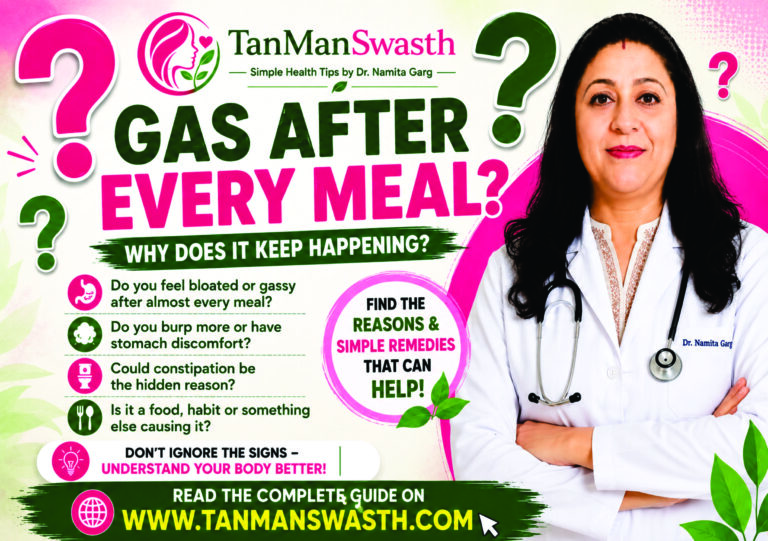
Do you feel gassy, bloated or uncomfortable after almost every meal?
Maybe you burp frequently. Maybe your stomach makes noises. Maybe you feel pressure or fullness and want to loosen your clothes after eating.
Gas itself is normal. It comes partly from swallowed air and partly from bacteria in the large intestine breaking down carbohydrates that aren’t completely digested.
The problem is when gas becomes frequent, uncomfortable or disruptive to your daily life.
So instead of simply asking:
“What should I take for gas?”
let’s first ask:
“Why am I getting so much gas?”
1. You May Be Eating Too Quickly
This is one of the simplest things to check.
When you eat quickly, you can swallow more air. The same can happen when you talk a lot while eating, chew gum, suck on hard candy or drink through a straw.
🌿 Try this
For your next meal:
Sit down → eat slowly → chew properly → don’t rush.
Put your spoon down occasionally instead of continuously eating.
It sounds very simple—but sometimes simple habits are worth testing before complicated remedies.
2. Fizzy Drinks May Be Adding to the Problem
Soft drinks, soda and other carbonated beverages can increase gas symptoms.
If you regularly have a fizzy drink with lunch or in the evening, try removing it for several days and observe what happens.
🌿 Simple swap
Instead of:
🥤 Fizzy drink
Try:
💧 Plain water
If your symptoms improve, you’ve found a useful clue.
3. Constipation May Be Sitting Behind Your Gas
This is particularly important because constipation and gas/bloating can occur together.
Ask yourself:
- Are your stools hard?
- Are you straining?
- Are you going less often than usual?
- Do you feel your bowel hasn’t emptied completely?
If yes, don’t treat the gas completely separately.
🌿 What can help constipation?
Gradually increase fibre from foods such as vegetables, fruits, pulses and whole grains, while drinking adequate fluids. Regular physical activity can also help bowel regularity.
Important: Don’t suddenly add huge amounts of fibre. A rapid increase can itself cause more gas and bloating in some people.
4. You May Have Increased Fibre Too Quickly
This surprises many people.
Fibre is important—but more is not always better when increased suddenly.
Suppose you decide to become healthier and suddenly start eating:
🌱 Lots of dal
🥗 Large amounts of vegetables
🌾 Whole grains
🥜 Nuts and seeds
Your digestive system may need time to adjust.
🌿 Better approach
Increase fibre gradually and drink adequate fluids.
If gas suddenly increased after a major diet change, look at the timing.
5. A Particular Food May Be Triggering Your Symptoms
Some carbohydrates are not completely digested in the small intestine.
When they reach the large intestine, bacteria break them down and produce gas.
Some people notice more symptoms after foods such as:
- Beans and some other legumes
- Certain vegetables
- Some fruits
- Dairy products
- Certain whole grains
- Foods containing certain sugar alcohols
But this does not mean these foods are unhealthy or that everyone should stop eating them.
Different people react differently.
🌿 Try a food-and-symptom diary
For a few days write:
Food → quantity → time eaten → when gas started → other symptoms
This can reveal patterns much better than randomly eliminating foods.
Doctors may also use food and symptom diaries when investigating gas symptoms.
6. Large Meals May Be Making You Uncomfortable
Some people find that smaller meals are easier to tolerate than very large meals.
This doesn’t mean you need to eat tiny portions all day.
Instead, notice what happens when you go from:
Very large meal → comfortable-sized meal
and see whether your symptoms change.
7. You May Be Eating While Distracted
TV, mobile phones, work and conversation can make us eat without paying attention.
You may eat faster, chew less and lose track of how much you’ve eaten.
🌿 Try the “slow meal” experiment
For one meal each day:
📵 Put the phone away
🪑 Sit comfortably
🍽️ Eat slowly
👄 Chew properly
⏸️ Pause occasionally
Then notice how you feel 30–60 minutes later.
8. Lack of Movement May Be Part of the Pattern
A day of sitting from morning to evening isn’t ideal for digestive health.
Regular physical activity can help digestion, and exercise may also help when you’re already feeling bloated.
🌿 Try this simple habit
After a meal, instead of immediately sitting on the sofa:
🚶 Take a gentle 10–15 minute walk.
Keep it comfortable.
You don’t need to turn it into a workout.
9. Sometimes Gas Is a Symptom of Another Problem
Frequent gas can sometimes occur with digestive conditions such as:
- Irritable bowel syndrome (IBS)
- Lactose intolerance
- Functional constipation
- Other digestive disorders
That’s why repeatedly taking something for “gas” without understanding the pattern isn’t always the best approach.
If symptoms keep returning, finding the underlying cause is more useful.
🌿 5 Simple Things You Can Try Today
If your gas is mild and you don’t have warning symptoms, start with these simple habits:
1️⃣ Eat slowly
Give yourself enough time to chew.
2️⃣ Reduce fizzy drinks
Especially if you notice they make symptoms worse.
3️⃣ Don’t suddenly overload on fibre
Increase fibre gradually.
4️⃣ Walk after meals
Try a gentle 10–15 minute walk.
5️⃣ Keep a food diary
Look for patterns instead of randomly eliminating foods.
These approaches are consistent with commonly recommended measures for reducing gas symptoms.
🌱 What About Ajwain, Jeera or Saunf?
These are common home remedies in Indian households.
Many people use:
- Ajwain
- Jeera
- Saunf
- Warm water
for digestive discomfort.
However, we should be careful about presenting these as proven treatments for every cause of gas.
If you find a particular food or drink comfortable and it doesn’t cause you problems, it can be part of your routine—but persistent or troublesome symptoms shouldn’t be managed only with home remedies.
🚫 Don’t Start Removing Everything From Your Diet
This is an important mistake.
If you get gas after eating, you may be tempted to stop:
❌ Dal
❌ Milk
❌ Wheat
❌ Vegetables
❌ Fruits
❌ All spicy food
Suddenly your diet becomes extremely restricted.
That’s not the goal.
Instead:
Identify the pattern → test one change → observe → adjust.
If symptoms are significant, a doctor or registered dietitian can help identify whether a specific intolerance or digestive condition is involved.
🚨 When Should You See a Doctor?
Occasional gas is normal.
But speak with a healthcare professional if your symptoms are frequent, persistent, worsening or interfering with everyday life.
You should be particularly cautious if gas or bloating occurs along with:
- Persistent abdominal pain
- Vomiting
- Diarrhea or significant constipation
- Blood in the stool
- Unexplained weight loss
- A significant change in bowel habits
Persistent bloating also deserves medical assessment rather than endless self-treatment.
❤️ TanManSwasth Takeaway
Gas after a meal doesn’t automatically mean:
“I ate the wrong food.”
It could be related to:
Eating speed + swallowed air + constipation + food patterns + sudden fibre increase + meal size + physical activity + digestive conditions.
So don’t start by removing half your diet.
Start with one simple question:
“What pattern do I notice before my symptoms begin?”
And try one small change at a time.
🌿 Your 3-day experiment
For the next three days:
Eat slowly + avoid fizzy drinks + take a gentle walk after meals + record what you eat and when symptoms occur.
You may learn more about your digestive pattern than you would from randomly trying different remedies.
TanManSwasth — Simple Health Tips by Dr. Namita Garg
Very very useful information indeed. Must follow.
thanks and welcome